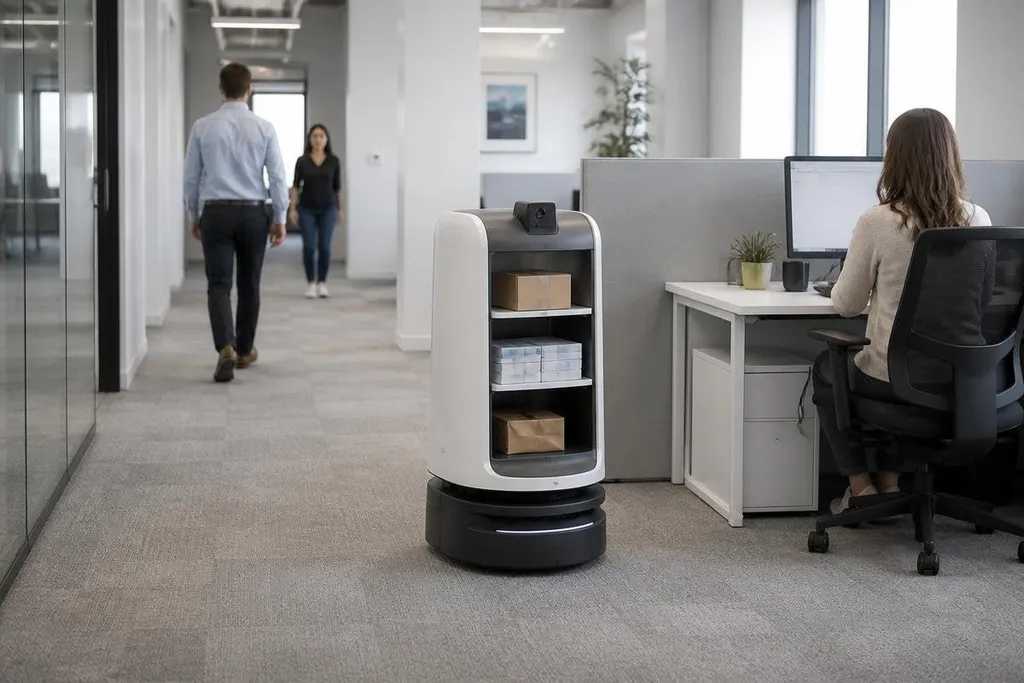
A robot that sorts mail, carries supplies, or answers a desk-side request may look like a major step. Without a named machine, test result, price, or deployment record, no honest article can rank office robotics results.
- A useful result cuts a real office task down to a measured result.
- The hard part is often handling people, doors, clutter, and changing instructions.
- A demo becomes useful evidence only when its limits are clear.
What counts as real progress
The word needs a test behind it. A machine that moves a box across a clear room may show working motion, but that alone says little about an office where chairs move, doors close, and people cross the robot’s path.
A stronger claim connects the machine to a task and a result. The useful details would include the task, the time needed, the number of successful runs, the human help required, and the conditions that caused failure.
That standard also keeps software and hardware in the same frame. Better vision matters when it helps a robot find a parcel on a crowded shelf. Better speech control matters when a worker can give a clear instruction without stopping to use a screen.
The office problems robots must handle
Office robotics covers several jobs, but they share one test: can the machine work in a place built for people rather than robots?
Moving through shared space
A mobile robot needs to avoid desks, visitors, bags, doors, and people who change direction without warning. Its map may use LiDAR, cameras, or both. The useful question is how it behaves when the map is wrong and a safe route disappears.
A claim about autonomous movement needs more than a smooth video. It needs the building type, the route, the number of trips, and the human actions used when the robot stopped.
Handling objects
Grasping a standard container is one task. Picking up a soft parcel, a loose cable, or a cup near the edge of a desk is another. A gripper must sense contact and control force so it can hold an object without crushing it.
Office work also brings a high mix of small tasks. That makes the object list more useful than a single successful pickup. A machine that handles five named items tells you more than a claim that it can handle “many” objects.
Working with people
Speech recognition, screens, lights, and emergency stops all shape the handoff between a person and a robot. The system needs a clear way to show what it heard, what it plans to do, and why it stopped.
This is where office robotics differs from a fixed industrial cell. A factory cell can control its work area. An office robot has to share space with people who did not come to work with a robot.
How to read the evidence
Office robots are judged by the work they finish, not the task shown in a short demo. Reports on office robots from Robot24.com can put the task, cost, and test record beside each claim before you decide what deserves a closer look.
A press demo can show that a task happened once. It does not show the cost of the robot, the training time, the service plan, or the rate of failed attempts. Those details decide if a machine belongs in a real office.
The missing figure matters too. If a maker has not published a price, say so. If a video cuts before the handoff, treat the handoff as unproven. If a trial has no count of completed tasks, don't turn it into a success rate.
I’d reject any office robotics claim that cannot name the task, the test conditions, and the result.
A buyer’s evidence checklist
Use these checks before approving a pilot:
- Name the task in plain words, such as room delivery or mail sorting.
- Ask for the success rate, the test count, and the conditions for each run.
- Record every human step, including remote control and manual recovery.
- Price the robot, software, setup, maintenance, and replacement parts.
- Check how the robot stops near people, doors, lifts, and blocked routes.
- Set one result that decides the next purchase step.
That last point turns a vague trial into a decision. A team might require the robot to finish a set number of deliveries per shift, with no remote recovery during normal operation. The target must come from the office task, not from a product brochure.
The next credible result will have a name, a measured task, a cost, and a failure record. Until those details appear, office robotics is a field of promising demonstrations rather than a ranked list of proven winners.